
 | News
Evaluating the Lao PDR Electronic Immunisation Registry
Lao People’s Democratic Republic (Lao PDR) is a low- and middle-income country in Southeast Asia with an estimated population of 7.6 million people.
Childhood immunisations are provided free of charge through government health facilities and outreach services.
However, geographic remoteness, language diversity, cultural norms and health literacy continue to shape access to immunisation services.
The most recent estimates of vaccination coverage indicate coverage of 76% for first dose diphtheria–tetanus–pertussis (DTP1), 67% for DTP3, and 69% for the first dose of measles containing vaccine (MCV1).
Timeliness of vaccination is also an issue, with only around two thirds of children vaccinated within recommended intervals.
Health care delivery in Lao PDR is primarily through the public sector and is organised across 4 administrative levels – central, provincial, district and health centre.
Although the country has made sustained investments in expanding access to primary healthcare, most immunisation services are delivered at health centres, many of which operate in resource constrained settings with low internet access.
In this context of immunisation service delivery, electronic immunisation registries (EIRs) can help improve immunisation coverage by making accurate, real-time data available to assist vaccination efforts and immunisation program monitoring.
Why an Electronic Immunisation Registry in Lao PDR?
Immunisation data in Lao PDR were traditionally collected using paper-based registers and monthly aggregate reporting in the District Health Information Software 2 (DHIS2), limiting visibility of individual vaccination histories, complicating identification of missed or overdue doses, and increasing the risk of data errors.
Outreach planning relied largely on population estimates rather than real time information.
Building on the introduction of a digital COVID 19 Vaccination Registry in 2021, Lao PDR implemented an EIR for routine childhood immunisation using the DHIS2 tracker platform.
Piloted in Vientiane Capital in 2022 and rolled out nationally by 2024, the EIR enables individual level data capture to support monitoring, analysis and decision making.
While EIRs are increasingly recognised as essential to modern immunisation systems and show promise in improving efficiency and data quality in low- and middle-income countries, evidence on how best to implement and sustain them in resource constrained settings remains limited.
What this evaluation examined
This mixed method evaluation, conducted from April 2024, examined the early implementation of the Lao EIR in Vientiane Capital and Vientiane Province.
It explored facilitators and barriers to implementation, health worker and stakeholder experiences, and the quality and use of EIR data to inform national rollout and system strengthening.
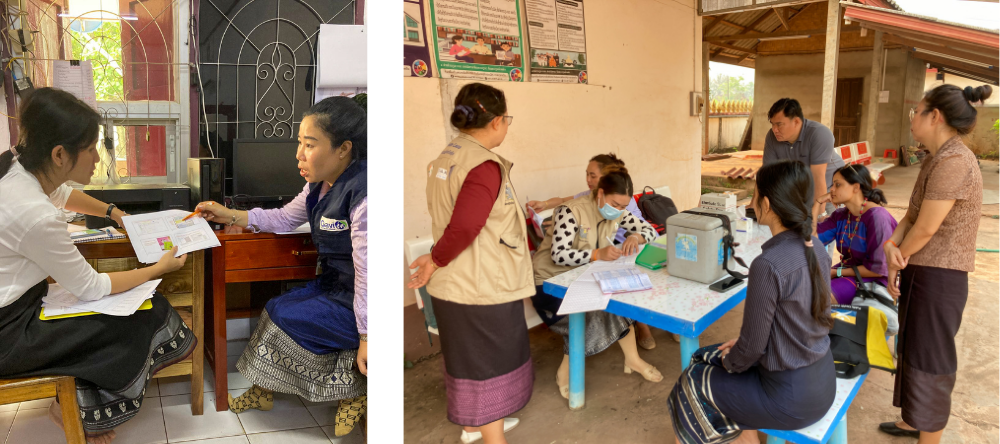
Across 26 health facilities, healthcare workers reported high acceptance and ease of use, with most finding the EIR helpful for checking vaccination status, identifying children due or overdue for vaccines, and generating reports.
The EIR was used alongside paper records as healthcare workers transitioned to the digital system, and views on workload impacts were mixed.
Many staff highlighted the need for additional and refresher training, particularly on data quality, reporting and data use.
Infrastructure challenges – including unreliable power and internet connectivity – were common and often required temporary work arounds.
Data quality analysis of more than 850,000 vaccination events identified issues typical of early digital systems, such as missing fields and delayed data entry.
However, the analysis also showed that the EIR captured more vaccination events than paper or aggregate reporting systems, underscoring its potential value.
Why this work matters
The Lao PDR evaluation provides practical, real world evidence on the implementation of a national EIR in a low resource setting.
It highlights that technology alone is not enough – successful digital health systems depend on workforce support, reliable infrastructure, clear governance and strong cultures of data use.
Importantly, the Lao PDR experience demonstrates how leveraging existing platforms such as DHIS2 and rolling systems out incrementally can accelerate adoption and acceptance.
At the same time, the findings highlight a persistent ‘last mile’ challenge – to convert improved digital data into routine public health action that strengthens outreach, improves timeliness and reduces the number of under-vaccinated children.
Addressing this gap will be central to ensuring that investments in immunisation data systems translate into measurable health gains.
A second phase of the evaluation is underway, with the Lao PDR Ministry of Health to test the use of EIR in improving childhood immunisation, including measles vaccination that happens later in life.
Partnerships and support
This study was funded by the Australian Government Department of Foreign Affairs and Trade through the Australian Expert Technical Assistance Program for Regional COVID 19 Vaccine Access: Policy, Planning and Implementation (AETAP PPI) as part of the Australian Regional Immunisation Alliance (ARIA).
It was led by Professor Meru Sheel and was a partnership between the University of Sydney, the Maternal Child Health Centre in Lao PDR, the World Health Organization, UNICEF and the Clinton Health Access Initiative country offices in Lao PDR.
The implementation of the EIR in Lao PDR has been supported by Gavi, the Vaccine Alliance and the Government of Japan.
Read the Lao PDR EIR evaluation paper published in npj Digital Public Health [PDF]