
 | News
Building trust in vaccines in Vietnam through community leadership
In 2022, Vietnam faced a growing challenge – increasing numbers of zero-dose children and declining uptake of COVID-19 booster vaccines.
Addressing vaccine hesitancy and strengthening trust in immunisation became a priority.
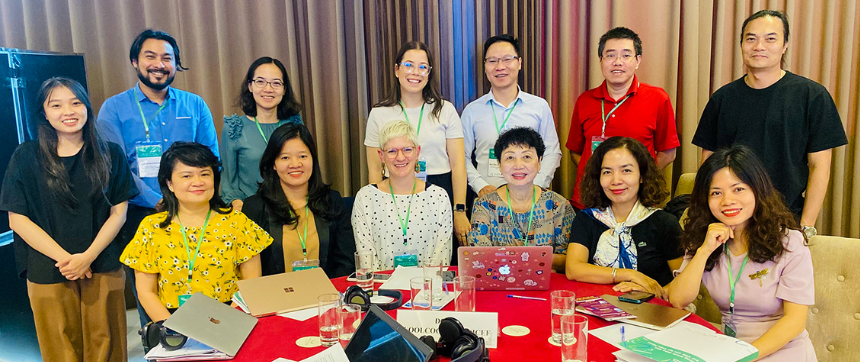
In partnership with the Vietnamese Ministry of Health, the Murdoch Children’s Research Institute (MCRI), NCIRS and other collaborators co-designed and delivered an innovative Vaccine Champions program – empowering health workers and community leaders to become trusted voices for vaccination.
A cascading model for sustainable impact
The program used a scalable ‘train-the-trainer’ approach to build capacity at every level of the health system.
First, Master Trainers trained Provincial Trainers, including healthcare workers and communication specialists.
Provincial Trainers then trained community leaders and other health workers as Vaccine Champions.
From there, Vaccine Champions delivered education sessions directly to communities.
Piloted in 2022 and expanded in 2023 across 3 low-coverage provinces, the program reached thousands of people with tailored, culturally appropriate vaccine information.
Strengthening confidence and communication
The program was evaluated using the RE-AIM framework to assess its reach, effectiveness, adoption, implementation and sustainability.
Key evaluation outcomes showed increased trust in vaccines and the health system, improved confidence in communicating about vaccination, and high participant satisfaction.
While gains in knowledge were modest, 86% of community members reported a greater intention to vaccinate, contributing to positive shifts in provincial-level vaccination coverage over time.
‘We know that knowledge alone isn’t enough to shift vaccination behaviours. This program demonstrates the importance of trust, dialogue and culturally relevant communication in supporting communities to make informed decisions about vaccination,’ said Professor Margie Danchin, Vaccine Trials and Uptake Group Leader at MCRI.
‘People everywhere trust familiar faces. When information comes from someone they know, they are more open to listening and learning,’ she added.
Beyond training – empowering communities
A key strength of the program is its sustainability.
Vaccine Champions are continuing to run community sessions and are now supporting broader health promotion activities alongside the Vietnamese Ministry of Health.
By equipping local leaders with the skills and confidence to engage their communities, the program is helping to reduce pressure on the healthcare workforce while strengthening long-term community trust.
A Vietnamese community member, now a Vaccine Champion, was asked about their experience and the program’s impact.
‘Before the training, I didn’t always feel confident answering questions about vaccines. Now I feel prepared to listen, address concerns, and support my community to make informed decisions for their children,’ they said.
Looking ahead
While early results show strong improvements in trust and intention to vaccinate, further research will assess the program’s long-term impact on vaccination coverage and cost-effectiveness.
The success of the Vaccine Champions model highlights its potential for scale-up within Vietnam and adaptation in other settings, offering a practical solution to address vaccine hesitancy and improve immunisation outcomes.
Partnership and support
This work was delivered by the MCRI in close collaboration with the Vietnamese Ministry of Health, the Sydney Vietnam Institute, NCIRS, UNICEF Vietnam and UNSW. It was funded by the Australian Government Department of Foreign Affairs and Trade under the Australian Expert Technical Assistance Program for Regional COVID-19 Vaccine Access: Policy, Planning and Implementation.